
Service
Audit
Good decisions start with good diagnosis.
Most development initiatives fail because they start from a flawed assessment. The leader senses that "something should change" — but without a clear picture of what works and what doesn't, the change becomes firefighting, not building.
Most businesses don't fall behind digitally because they don't want to change, but because they don't know what the first step is. That's why we always start with a diagnosis.
The six areas we examine
An organization's operation consists of six fundamental areas — like the six sides of a honeycomb cell. Each one connects to the others. If one is weak, the rest cannot be strong either.
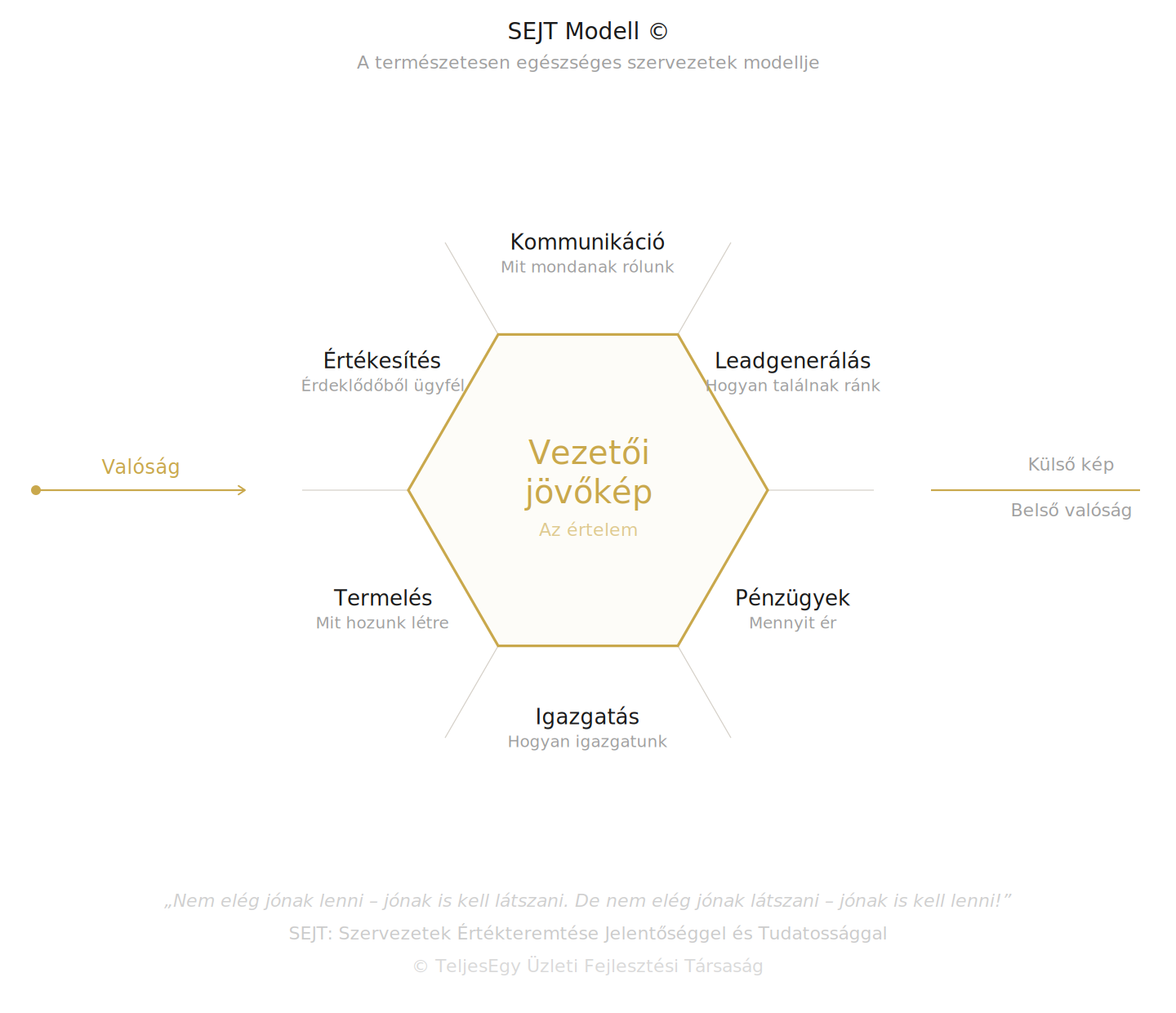
The six areas form three pairs. Each pair has an internal and an external side — like reality and its reflection. The internal is what we do. The external is how the world sees us.
"It's not enough to be good — you also need to look good. But it's not enough to look good — you also need to be good!"
At the center stands the leadership vision: the reason the organization exists and the direction it is heading. Only from this starting point can a strategy be sound.
Production
What we create
The essence of any organization: the product or service it creates. In a healthy organization, production processes are clear, documented, and automated. Important: only a streamlined process — free of unnecessary steps — is worth digitizing.
Management
How we govern
The system of rules and their enforcement. Without this, production is like rolling dice. Administrative order, process catalog, onboarding, performance management, and reporting. The most important rule: we can only manage what we can measure.
Finance
What our work is worth
Not just accounting — but understanding which products generate value and whether what we do is worthwhile. In a healthy organization, the financial system is a decision-making tool, not an afterthought of administration.
Communication
What they say about us
Our website, social media, professional presence. A healthy organization consciously shapes the image formed about it. Communication success: when satisfied people say about us what we originally intended them to.
Lead Generation
How they find us
Being appealing is not enough — you also need to convince the buyer. Keyword research, targeting, behavioral analysis, remarketing. Not random, but a complete system. A crate of healthy apples at the market — people will gather around.
Sales
How prospects become clients
How we follow up with prospects, how we personalize the offer — and how we ensure this works at scale, not just with ten but with a thousand clients. Not person-dependent — system-dependent.
+1: Leadership Purpose — why we exist
The center from which everything else follows. The founder's vision of why the organization was created and what value it generates. It is twofold: there is a "why" (the purpose) and a "what for" (the goal). If this is clear, the other six areas fall into place. If it is missing or vague, any development is merely treating symptoms. Only a sound starting point can produce a sound strategy.
What to expect during the assessment
We always conduct the assessment in a focused manner: one area at a time under the microscope. Reviewing a single area can take anywhere from 1-2 hours to several dozen hours, depending on company size and complexity.
We send the questionnaire in advance so you can prepare, making our collaborative work as time-efficient as possible.
If multiple organizational units are involved, we survey team members with a brief questionnaire. Depending on the nature and extent of the challenge, we may map the current situation through a workshop or personal consultation.
Service
We understand where you stand
Assessment
We examine all 6+1 areas through personal interviews and targeted questionnaires. We look not only at processes, but also at how people relate to change. The assessment covers digital maturity and AI readiness as well.
Diagnosis
We compare the current state with opportunities across all six areas. The diagnosis result is not a dry 180-page document, but a clear picture of what the most important action is — and why.
Development Plan
A prioritized, concrete roadmap: what to do first, with what resources, over what timeframe. If grant funding is available (e.g. DIMOP Plus), we design the plan so that a grant application can be built upon it.
Certificate
As a result of the audit, we issue a certificate that verifies the organization's digital preparedness, AI maturity, or organizational health.
Duration: 1-4 weeks
Analyses and studies
If the situation calls for it, we prepare a deeper analysis on the audit topic. How does your industry stand digitally? Which automation opportunities would deliver the fastest return? Which AI solutions are relevant?
These are not academic papers, but materials that support executive decision-making, ready to be applied directly.
Who is the audit for?
For the leader who wants to see clearly before taking action. Who has already tried something that didn't work, and now asks for the first time: why? Who knows that the feeling of "we should do something digital" is not a strategy in itself.
Frequently asked questions
What makes the TeljesEgy audit unique?
Most audits examine only technology or only processes. We look at the SEJT Model© 6+1 areas simultaneously: production, management, finance, communication, lead generation, sales — and at the center, the leadership vision. We don't recommend software — we show where the organization's greatest development potential lies, whether it's technological, organizational, or human.
How much does it cost?
Every audit is tailored, so we provide pricing after understanding the situation. In the free 30-minute conversation, we determine the depth of assessment needed, and based on that, we prepare a proposal.
Can it be used for grant applications?
Yes. If after the audit you wish to implement the development using grant funding — for example within the DIMOP Plus or GINOP Plus frameworks — our development plan provides the foundation for the grant application. We don't write the grant application, but the planning phase is our deliverable.
What if it turns out that technology is not needed?
This is often what we find. Management and production are rarely technology issues. If there is no clear process, no stable governance, or no clear vision, the best software won't help. In such cases, we still tell you what to do — we just won't recommend software.
Want to see clearly before you act?
Let's start with a conversation.